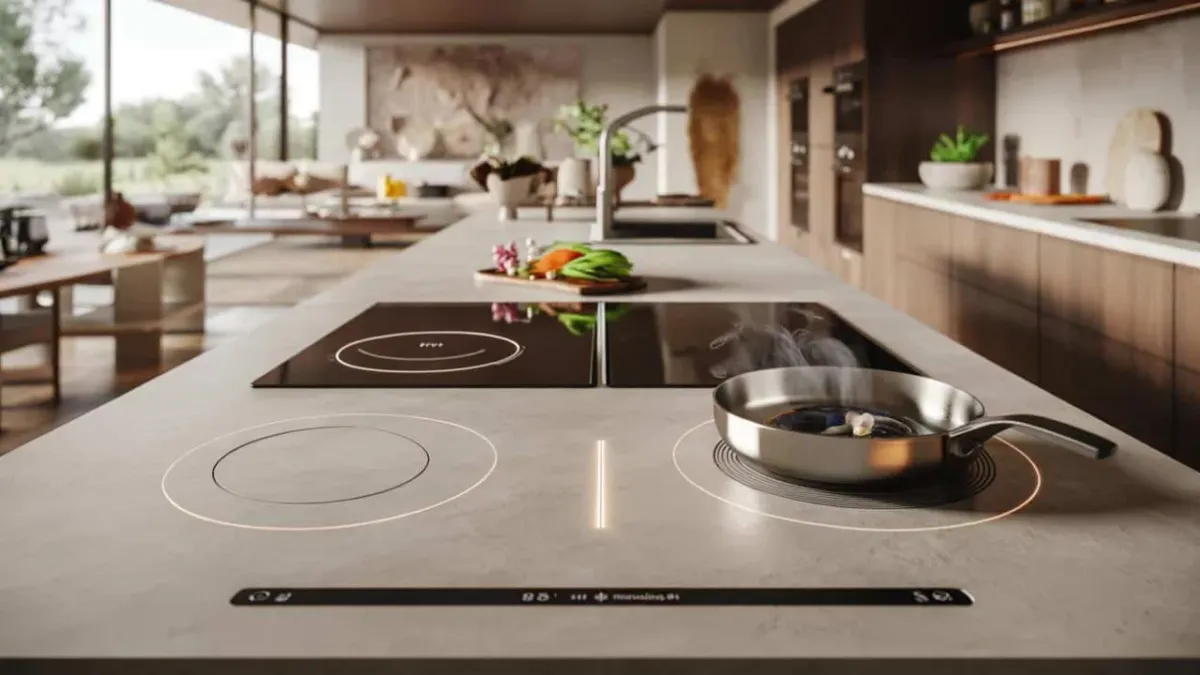
How Invisible Induction Hobs Work and Look
Invisible induction hobs use induction coils placed beneath specially chosen countertop materials like engineered stone, technical ceramic, and sintered stone. These surfaces are ultra-dense and non-porous, made to handle rapid temperature changes and avoid cracking. The coils heat pans directly through magnetic fields, while the countertop itself stays fairly cool, only warming a bit from residual heat.
Cooking zones are shown subtly: by engravings, tiny LED indicators, or slight texture changes. Controls have moved to discreet touch panels along cabinet edges or, in some premium models, to smartphone apps. Performance matches regular induction hobs and they still require induction-compatible cookware (i.e., magnetic-bottom pans).
Design and Function: What’s New
Invisible induction hobs affect both technology and kitchen layout. Kitchen designer Marcus Chen says they remove visual clutter and create a smooth extension of the kitchen’s architecture. “We’re not just removing visual clutter,” he says. With no raised cooking surfaces, homeowners get continuous work areas and more usable counter space.
Celebrity chef Antonio Rossi reports that after retrofitting his London restaurant with them, his cooks gained 40% more work surface. Rossi’s experience shows how these hobs can boost space efficiency, which is especially useful in busy commercial kitchens.
Challenges and What’s Happening in the Market
Invisible induction hobs bring benefits but also challenges. Traditional induction uses thin glass tops; invisible systems must contend with the thickness of dense stone or ceramic. Engineers have responded with stronger magnetic coils and advanced sensors that detect pans and improve safety. Still, installation needs specialized skills, not all countertop materials are compatible, and retrofits, when possible, can be complex and costly.
On price, invisible induction hobs currently cost 2, 3 times more than traditional models. Manufacturing costs have fallen by 35% since 2022, though. Market interest is growing: kitchen retailer James Morrison says inquiry rates have tripled year over year. That growth is especially visible in Europe, where EU energy regulations favor efficient induction technology.
Looking Ahead: Cooking Surfaces of Tomorrow
Major appliance brands are investing in this technology, and invisible induction hobs are gaining traction in high-end homes and commercial spaces. They suit minimalist designs and are appealing in smaller homes where every inch of countertop matters. Appliance engineer Lisa Rodriguez notes the surface becomes “part of the room’s DNA,” reflecting a shift toward fully integrated cooking environments.
While they often require a significant upfront investment, invisible induction hobs offer practical benefits, added safety features, and a modern design that many find attractive. If adoption continues, these cooking surfaces could become standard in more kitchens worldwide, offering a sleek, modern option that fits contemporary lifestyles.