Hidden Rock Found in American Yard Revealed as Ancient Archaeological Find
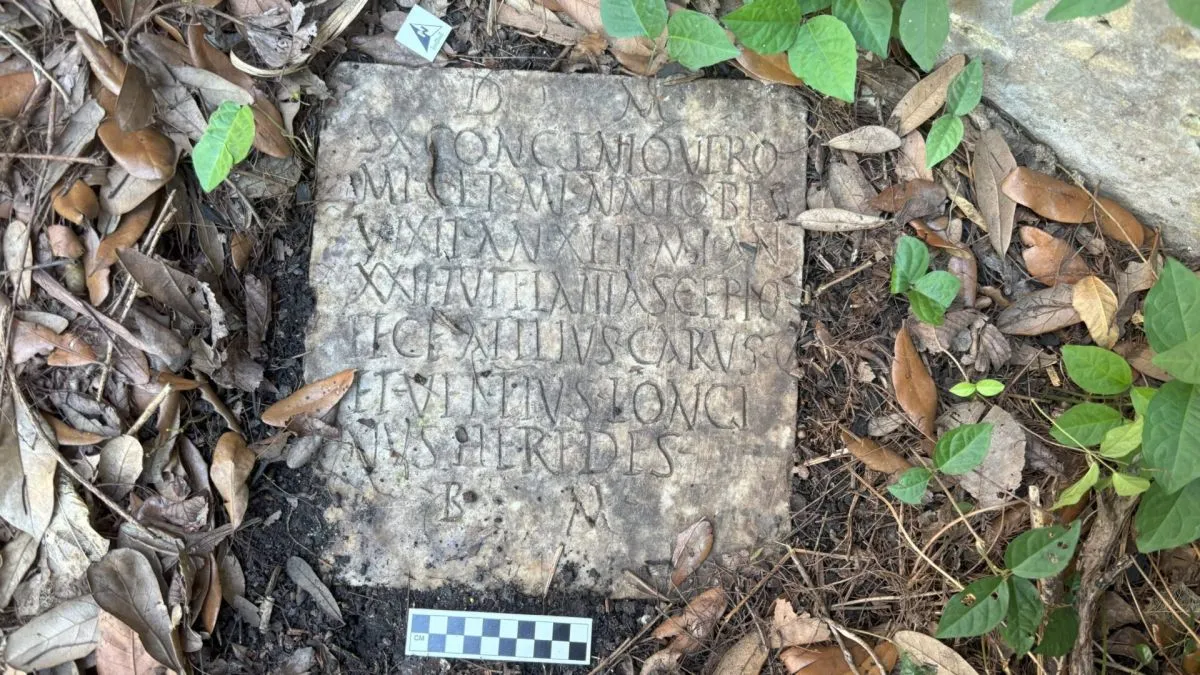
A plain backyard in suburban New Orleans yielded an ancient artifact. Homeowners Daniella Santoro, an anthropologist, and her husband Aaron Lopez dug up a marble slab in their overgrown garden that turned out to be a Roman funerary marker dated nearly 1,900 years ago. What first looked like a garden ornament has been identified as an object with wartime provenance and is slated for return.
A Garden Find With Deep Roots
The slab was found in the historic Carrollton neighborhood of New Orleans, Louisiana, where Santoro’s professional eye was alerted by an object half-buried in the undergrowth. At first it was mistaken for a mass-produced garden statue, but the Latin inscription “Dis Manibus” (translated to “to the spirits of the dead”) made it clear this was a Roman tombstone. That phrase commonly appears on Roman funerary stones meant to honor the dead.
The tablet commemorates Sextus Congenius Verus, a Thracian who served in the Roman military for 22 years and died at the age of 42.
Recognizing the importance of the find, Santoro contacted academic specialists, including Susann Lusnia, an archaeologist at Tulane University, and D. Ryan Gray, an anthropologist at the University of New Orleans. Their joint analysis confirmed the object was a Roman funerary tablet and linked it to earlier documentation from the National Archaeological Museum of Civitavecchia in Italy in the early 20th century.
How It Ended Up in Louisiana
The tablet’s provenance spans museum custody, wartime disappearance, and private ownership. During the Allied bombings of 1943 and 1944 in World War II, the Civitavecchia museum was badly damaged and many items disappeared, including this tablet. During the subsequent chaos and looting across Europe, numerous cultural objects went missing for decades.
Sometime after the war, the tablet made its way to the United States. Charles Paddock Jr., a soldier stationed in Italy, brought it home, and it sat in his Gentilly house until the 1980s. His granddaughter, Erin Scott O’Brien, later found it on display among other family heirlooms. When O’Brien moved into a Carrollton house in the early 2000s, she placed the stone in her garden, thinking it was just decorative.
Sending It Back: Repatriation and Closure
Santoro’s rediscovery prompted steps to return the stone to Italy. The FBI’s Art Crime Team is leading efforts to repatriate the tablet to the National Archaeological Museum of Civitavecchia.
The tablet’s documented history now runs from a Roman gravesite to the museum in Civitavecchia, wartime disappearance, private ownership in New Orleans, and a planned return to the museum where it had been recorded in the early 20th century. The full chain of movement during the war may never be completely known, but the repatriation addresses the tablet’s wartime displacement and restores it to the institution that originally documented it.