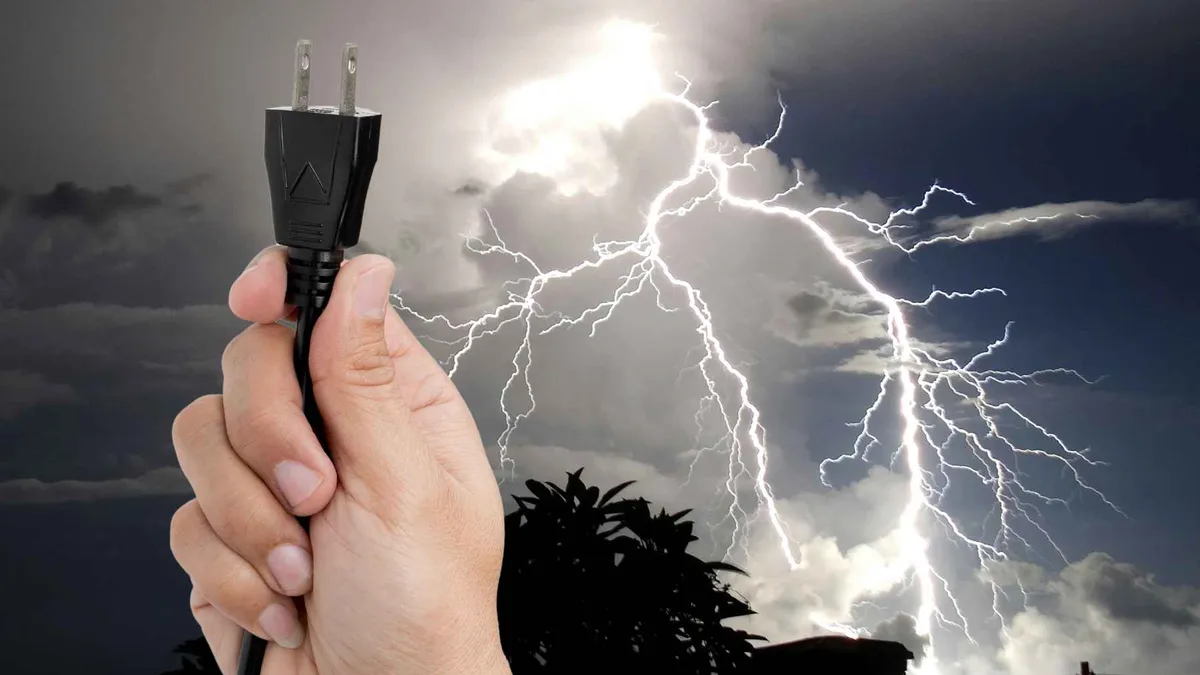
These days TVs, LED, QLED, OLED, require steady power to run their sensitive components. That slim set on your living room stand is often more vulnerable when bad weather arrives.
How Lightning and Power Surges Threaten Your TV
Lightning does not have to hit your house to cause trouble. A nearby strike can push thousands of extra volts through your home wiring, and those spikes can fry weak points on a TV’s circuit boards in seconds.
There are two main types of damage from storm-related power problems: instantaneous and cumulative. One big surge can instantly destroy power supplies or main boards. Repeated small hits, micro outages and frequent power cycling, can slowly wear down parts like capacitors until something fails and needs repair.
How To Unplug Your TV Properly
Turning the TV off with the remote does not disconnect it from the power supply. The only reliable way to protect your TV is to unplug it from the wall or power strip before the storm hits. Waiting until you see flickering lights or until the storm is in full swing can be too late.
Also remember other paths a surge can take: antenna leads, cable TV lines, and HDMI cables that link to external devices. Those connections can carry a surge straight into your TV, so technicians recommend unplugging those cables during strong storms to protect the electronics down the chain.
Why Surge Protectors and Cheap Stabilizers Aren’t Enough
Many households rely on basic voltage stabilizers or inexpensive surge strips. Specialists at the Instituto Nacional de Tecnología Industrial (INTI) say the energy released by a lightning strike usually exceeds what these home devices, or small uninterruptible power supplies (UPS), can handle. Higher-grade protections built to national standards can help, but unplugging electronics while a thunderstorm is active remains the most reliable protection.
Other Devices That Can Be Hit
It is not just TVs. Modems, Wi‑Fi routers, streaming boxes, game consoles, and audio receivers also have sensitive circuit boards and are at risk from surges. Safety guides typically recommend unplugging these gadgets right after the TV when a storm is coming. Because they are often clustered in entertainment centers or home offices on the same outlet, taking a minute to disconnect them could save several pieces of equipment.
By contrast, simple heating appliances like kettles and toasters are usually more robust and less likely to be damaged by a surge. The priority should be protecting sensitive electronics when the weather turns severe.
Protecting your TV and other electronics from storm-driven power surges requires more action than many people expect. Surge protectors and UPS units offer some protection, but unplugging is the most reliable safeguard. Unplugging can prevent major damage and reduce repair or replacement costs. When the next storm is on the way, do not just unplug the kettle; unplug sensitive electronics connected to the electrical supply.