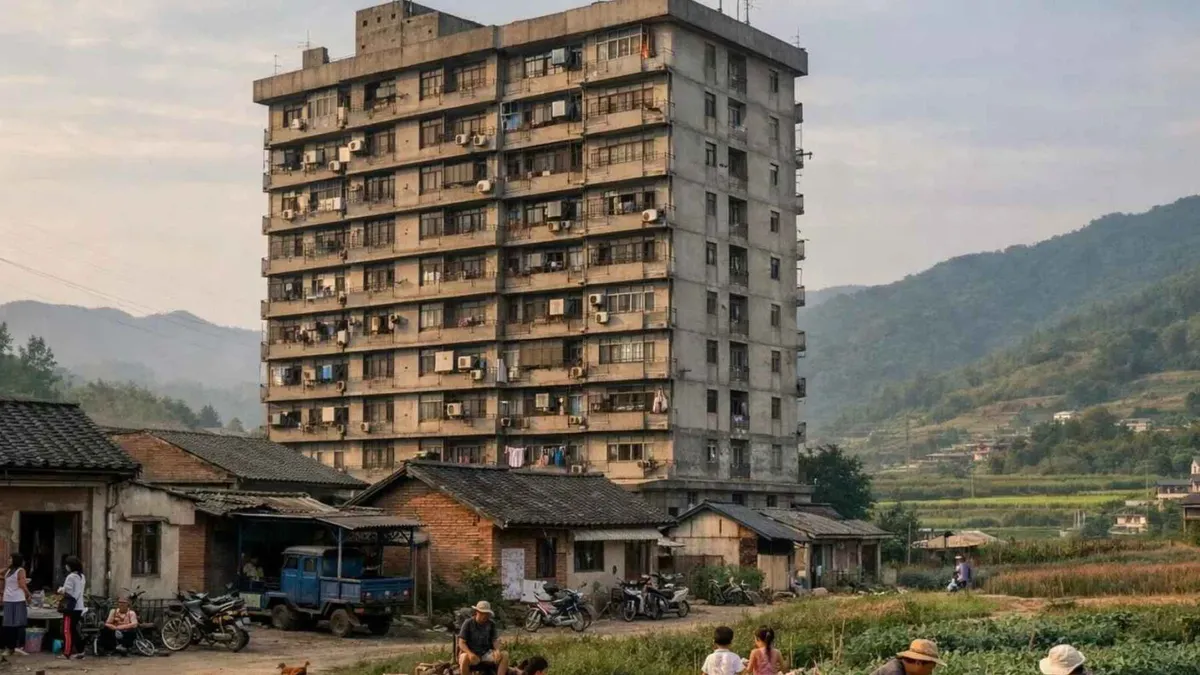
A Plan for Staying Together
Sitting in the middle of Zhuyuan Village, the Zhu family’s tower is meant to be a “vertical village” rather than just another apartment building. It holds more than 100 relatives across four generations, all under one roof.
There are 22 fully equipped apartments on floors two through twelve, giving family members private, independent homes. The ground floor, originally planned as a store, now serves as a food storage area and a playground for kids.
The idea came from necessity: older homes were cramped, and everyone wanted more space and privacy. Instead of moving into separate houses, the family pooled money from about 20 related households to build together. The shared tower keeps older adults, children, and relatives who return from other cities close by, while still preserving privacy.
Social and Environmental Benefits
The Zhu tower raises questions about energy use and sustainability. The United Nations Environment Programme (UNEP) says buildings and construction account for 32% of global energy consumption and 34% of global CO2 emissions. Compact urban forms like apartment buildings are often cited as a way to lower per-person emissions and save energy; the Intergovernmental Panel on Climate Change (IPCC) supports this view.
The IPCC finds that compact, walkable, higher-density cities could reduce urban energy use by 20% to 25% before 2050. The U.S. Energy Information Administration (EIA) reported that, in 2020, energy use in single-family homes was nearly three times that of apartments in buildings with five or more units. That difference indicates potential energy savings from shared living arrangements such as the Zhu family’s.
Challenges to Think About
Building a concrete tower comes with an upfront carbon cost. Cement and steel, the main materials in such structures, contribute to 18% of global emissions. This raises questions about weighing immediate emissions from construction against potential long-term savings from denser living.
Success for projects like this depends on several factors: public acceptance, spatial planning, building longevity, and maintaining high occupancy rates. The IPCC stresses adding green spaces and essential services (like shops and healthcare) to maintain living quality. So while vertical living has potential, it requires careful planning and attention to social and environmental details.
The Zhu family’s tower illustrates how traditional family arrangements can adapt to urban pressures. It offers practical lessons for policymakers and architects on community, energy use, and more efficient use of space in crowded areas.