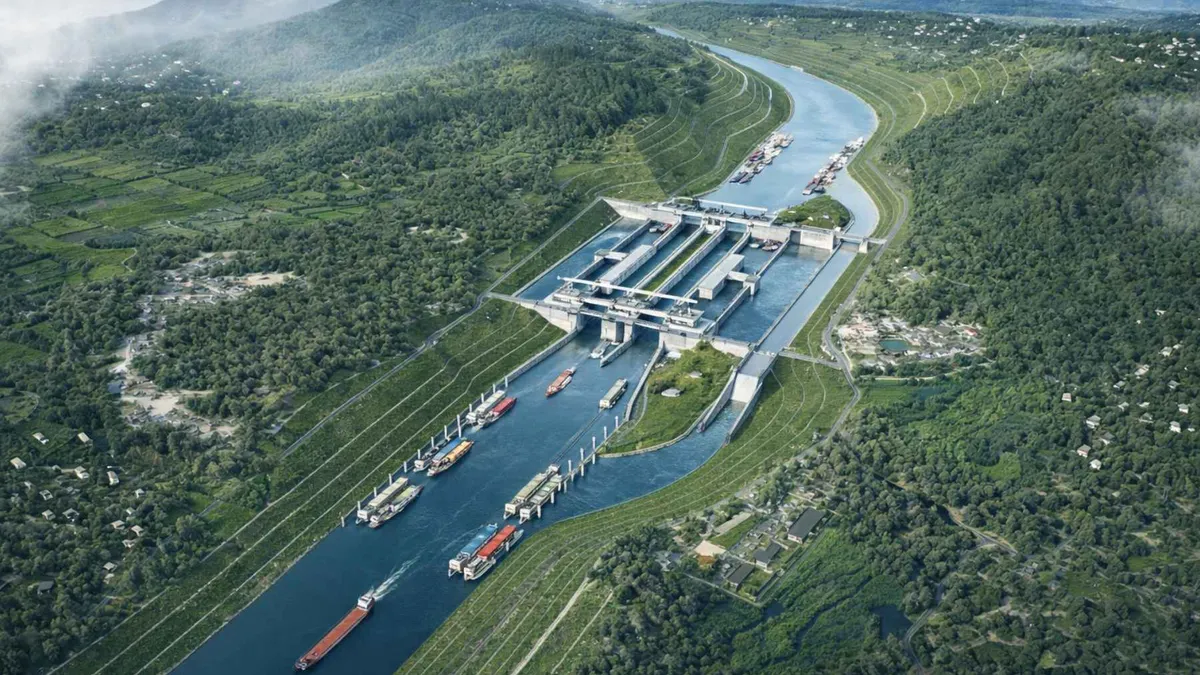
The Route and Why It Matters
The canal starts in the Nanning area of Guangxi Province, follows the Qinjiang River south, and ends at the Beibu Gulf. The new route will shorten current paths by about 348 miles compared with routes that detour through Guangdong.
Local authorities say the canal is part of the “New International Land-Sea Trade Corridor,” and state media calls it the first major river-to-sea canal project since the founding of the People’s Republic of China.
Completion is expected in late 2026. As of late February 2026, more than 90 percent of the canal route had taken shape, and roughly 92 percent of the planned budget, about 72.7 billion yuan (roughly $10.5 billion USD), had already been spent.
Economic and Logistics Effects
Economically, the Pinglu Canal could alter logistics in the region. It is expected to cut logistics costs by more than $754 million a year. Those savings are likely to reduce transportation costs for factories and ports and affect consumer prices by giving manufacturers in Nanning and the wider southwest a faster path to the sea.
The canal is designed for 5,500-short-ton class ships, which is about 11 million pounds of cargo per vessel. With that capacity and location, the canal may attract industry to its banks and help form an industrial corridor.
How It’s Built and How It Handles the Environment
Engineering includes three major ship lock hubs to handle a 213-foot water level difference. The locks raise or lower vessels by filling or draining chambers. The Madao hub is described by project materials as a “water-saving” lock site because of the large volumes of water involved in moving ships uphill or downhill.
The project includes 36 ecological conservation areas intended to protect old river bends and oxbow lakes. The Qingnian hub features a 1,575-foot fish passage equipped with sensors and cameras to monitor fish movement and help them pass safely. There will also be animal crossings to help wildlife move across the canal and long-term habitat monitoring, measures noted in the context of warnings about potential habitat fragmentation in a 2025 paper in the journal Land.
Trade Shifts and What’s Next
The Pinglu Canal arrives as trade flows change. In 2025, China’s exports to ASEAN rose by 13.4 percent, while shipments to the United States fell by about 20 percent. That same year, the Beibu Gulf port system handled more than 10 million TEUs, reflecting growing trade ties with Southeast Asia.
China’s transport authorities are testing “smart” navigation and support systems to automate and fine-tune canal operations. If implemented successfully, the canal may function as a significant trade route and provide data on operating large infrastructure alongside ecological measures. It may draw attention from industry and policymakers considering how large construction projects can coexist with natural habitats.