Fixing Dishwasher Smells, Rust, and Spots
Lingering bad smells in dishwashers often come from food residue, moisture, and bacteria. Regular cleaning doesn’t always remove them, and some people reach for chemical deodorizers. Anna Schmidt, a 42-year-old graphic designer from Hamburg, said, “I was so frustrated by the constant water spots on my glasses. A friend recommended the trick with the cork. I was skeptical, but the result was incredible: crystal-clear dishes as if they were new!” The cork’s porous structure soaks up odor molecules, keeping the machine fresher for longer without adding artificial fragrances.
Flash rust: those tiny brown particles that show up on stainless steel cutlery and glasses, usually comes from non-stainless parts like screws on pots, old baking trays, or damaged dish racks. The rough, absorbent surface of a cork grabs and holds those rust particles before they settle on your dishes. That helps keep dinnerware spot-free and can slow down corrosion, extending the life of your cutlery.
Keep Your Cutlery Shiny
Even top-quality stainless flatware can lose its shine over time. Microscopic deposits, rust particles and limescale, scatter light and make utensils look dull. Polishing by hand works but is time-consuming. Tossing a cork in with your silverware removes flash rust during the wash cycle, so that matte layer doesn’t form and your cutlery stays shiny. Anna even nicknamed it “the oak-bark product” for how well it worked.
Why a Cork Works
Cork is lightweight, elastic, and highly absorbent because it’s made up of millions of tiny, air-filled cells. One key component of that structure is suberin (a water-repellent substance that binds fats, oils, and fine particles), which helps the cork act like a passive filter during wash cycles. Real natural corks have the porous architecture needed for this; synthetic or pressed corks with lots of glue do not perform the same way.
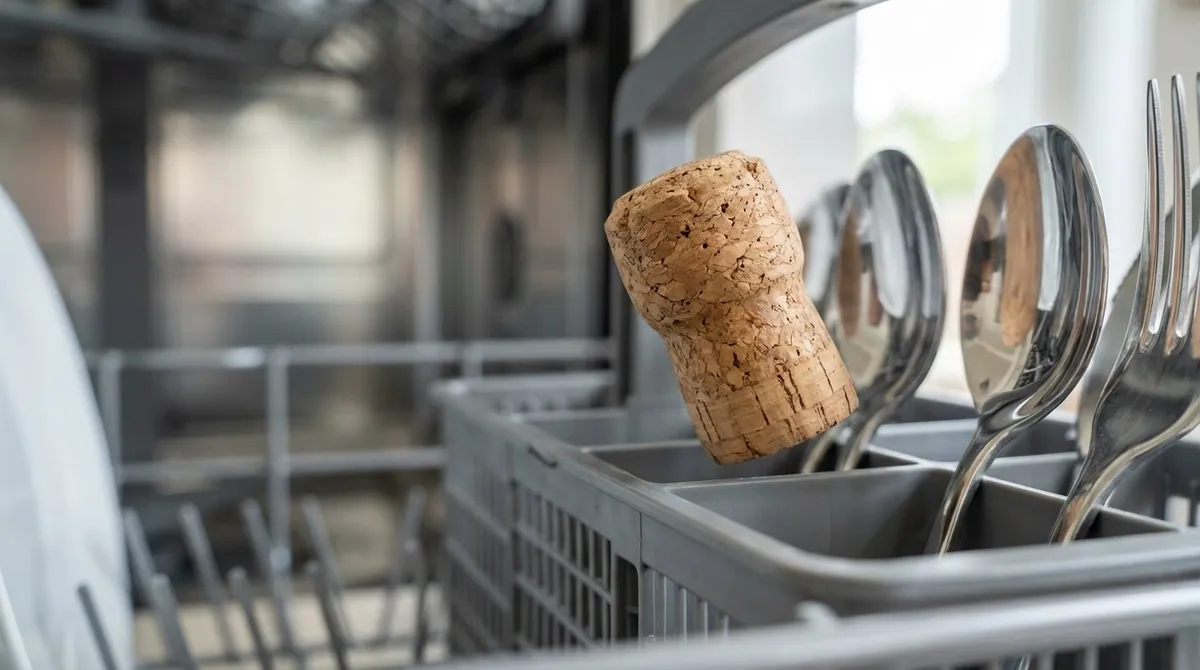
Using a cork is simple. Place it in the cutlery basket or drawer where it won’t move around or block anything. After about 20 to 30 wash cycles, the cork’s absorptive power drops and it should be swapped out for a new natural cork. It will not clog the drain or spray arms, and it will not leave any taste or smell on your dishes; dishwasher detergent and high wash temperatures neutralize any residues.
As a household tip, some people use cork in the dishwasher to avoid added chemicals; others prefer specialty products. Because of its physical and chemical properties, a natural wine cork is a straightforward solution for these common dishwasher problems. Reusing wine corks can reduce waste and cut costs.